Safe Irradiance Levels For Blue Light Therapy: A Comprehensive Scientific Guide
 May 18, 2026|
 Introduction
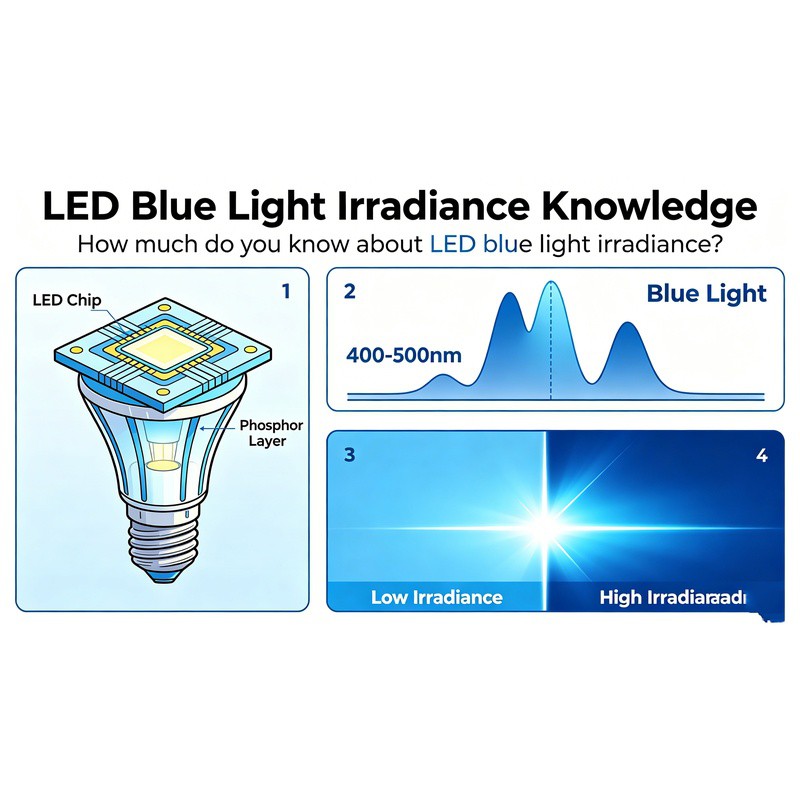
Blue light phototherapy (400–500 nm) has emerged as a safe, non-invasive treatment for various dermatological conditions, including acne vulgaris, atopic dermatitis, and psoriasis, as well as neonatal hyperbilirubinemia. However, its therapeutic efficacy and safety depend critically on precise control of irradiance-the power of light per unit area reaching the skin surface.
This article provides evidence-based irradiance guidelines aligned with the latest international standards, helping consumers and healthcare professionals make informed decisions about blue light therapy devices and protocols.
What Is Irradiance and Why Does It Matter?
Irradiance (measured in mW/cm² or W/m²) quantifies the intensity of light energy delivered to a specific area. Unlike total power output (watts), irradiance accounts for the distance between the light source and the target surface, following the inverse square law:
Doubling the distance reduces irradiance to 1/4 of the original value
Halving the distance increases irradiance to 4 times the original value
Therapeutic effects occur within a narrow irradiance window. Too low, and treatment is ineffective; too high, and it can cause oxidative stress, skin damage, or retinal injury. The total energy delivered (fluence, measured in J/cm²) is calculated as:
Fluence (J/cm²) = Irradiance (mW/cm²) × Time (seconds) ÷ 1000
International Photobiological Safety Standard: IEC 62471-7:2023
The IEC 62471-7:2023 standard (updated with Interpretation Sheet 1 in January 2025) is the global benchmark for evaluating the photobiological safety of lamps and light systems, including blue light therapy devices . It classifies products into four risk groups based on blue light hazard (400–500 nm):
表格
| Risk Group | Blue Light Weighted Radiance Limit | Safety Description |
|---|---|---|
| RG0 (Exempt) | ≤ 100 W/(m²·sr) | No hazard under any normal use conditions; unlimited exposure time |
| RG1 (Low Risk) | ≤ 10,000 W/(m²·sr) | Safe for intended use; no protection required for exposure up to 100 seconds |
| RG2 (Moderate Risk) | ≤ 100,000 W/(m²·sr) | Requires warning labels; avoid direct eye exposure > 0.25 seconds |
| RG3 (High Risk) | > 100,000 W/(m²·sr) | Hazardous even for brief exposures; not suitable for consumer use |
Critical Note: All reputable blue light therapy devices for home use must be certified RG0 or RG1 . Devices without IEC 62471 certification pose unknown risks to eyes and skin.
Safe Irradiance Levels for Dermatological Blue Light Therapy (450–470 nm)
The therapeutic window for blue light in dermatology targets bacterial porphyrins (for acne) and modulates inflammatory pathways. Below are evidence-based irradiance guidelines:
1. Home Use Devices (Consumer-Grade)
Maximum safe irradiance: ≤ 40 mW/cm² (400 W/m²)
Recommended therapeutic range: 10–20 mW/cm²
Treatment duration: 15–20 minutes per session
Frequency: 1–2 times daily, 3–5 times weekly
Maximum daily fluence: ≤ 24 J/cm² (at 20 mW/cm² for 20 minutes)
Clinical studies confirm that within this range, blue light effectively reduces acne lesions by 60–70% over 4–8 weeks without damaging the skin barrier . Exceeding 40 mW/cm² increases the risk of:
Transient erythema and skin dryness
Oxidative stress in keratinocytes
Post-inflammatory hyperpigmentation (especially in skin types III–IV)
2. Medical-Grade Devices (Clinical Use)
Standard treatment: 10–20 mW/cm² for 15–30 minutes
High-intensity protocols: 20–40 mW/cm² (under medical supervision only)
Maximum clinical irradiance: ≤ 80 mW/cm² (for short-duration, targeted treatments)
Medical devices may use higher irradiances because they are administered by trained professionals who can monitor for adverse effects and ensure proper eye protection.
Neonatal Jaundice Phototherapy: Specialized Safety Standards (460–490 nm)
Neonatal phototherapy requires precise spectral and irradiance control to effectively convert unconjugated bilirubin while minimizing risks to the infant's developing eyes and skin. The 2022 American Academy of Pediatrics (AAP) Clinical Practice Guideline provides the gold standard :
AAP Recommended Irradiance Levels
Conventional phototherapy: ≥ 10 μW/cm²/nm (spectral irradiance)
Intensive phototherapy: ≥ 30 μW/cm²/nm (for high-risk infants with rapidly rising bilirubin)
Maximum safe irradiance: ≤ 70 μW/cm²/nm (efficacy plateaus above this level)
Optimal wavelength: 475–478 nm (peak bilirubin absorption)
Critical Safety Considerations for Infants
Distance: Maintain 30–40 cm between the light source and the infant's skin
Eye protection: Mandatory opaque eye patches at all times during treatment
Body surface area: Expose as much skin as possible (35–80%) for maximum efficacy
Temperature monitoring: Prevent overheating (infant core temperature should remain 36.5–37.5°C)
Key Factors Affecting Safe Blue Light Exposure
1. Eye Protection
Blue light (400–450 nm) penetrates the cornea and lens to reach the retina, where it can cause photochemical damage. Always wear certified blue light protective goggles with an optical density (OD) ≥ 4 during facial treatments . Infants must wear properly fitted eye patches that completely cover both eyes.
2. Treatment Timing
Avoid blue light therapy within 2–3 hours of bedtime, as it suppresses melatonin production by 60–80% and can disrupt sleep cycles . Morning treatments are ideal for maintaining circadian rhythm.
3. Skin Type Considerations
Skin types I–II: Start with lower irradiance (10–15 mW/cm²) and shorter durations (10–15 minutes)
Skin types III–IV: May tolerate up to 20 mW/cm², but monitor closely for hyperpigmentation
Photosensitive individuals: Avoid blue light therapy or use only under medical supervision
4. Device Quality
Choose devices with:
IEC 62471-7:2023 certification (RG0 or RG1)
Uniform irradiance distribution across the treatment area
Accurate timer and intensity controls
Clear safety instructions and warnings
Common Misconceptions About Blue Light Therapy Safety
"More power = better results": False. Efficacy plateaus at around 40 mW/cm² for dermatological applications. Higher intensities only increase the risk of adverse effects.
"Blue light causes skin cancer": Unlike UV radiation, blue light does not damage DNA directly and is not carcinogenic .
"All blue light is the same": False. Therapeutic blue light (450–470 nm for skin, 460–490 nm for jaundice) is different from the high-energy blue light emitted by digital screens (410–450 nm).
Conclusion
Blue light therapy is a safe and effective treatment when used within evidence-based irradiance guidelines. For home use, stick to devices certified to IEC 62471-7:2023 (RG0 or RG1) with irradiance levels between 10–20 mW/cm². Always protect your eyes, follow recommended treatment durations, and avoid late-night sessions.
For medical conditions or neonatal jaundice, consult a healthcare professional to ensure proper diagnosis and treatment planning.
Disclaimer: This article is for informational purposes only and does not constitute medical advice. Always consult a qualified healthcare provider before starting any new treatment regimen.